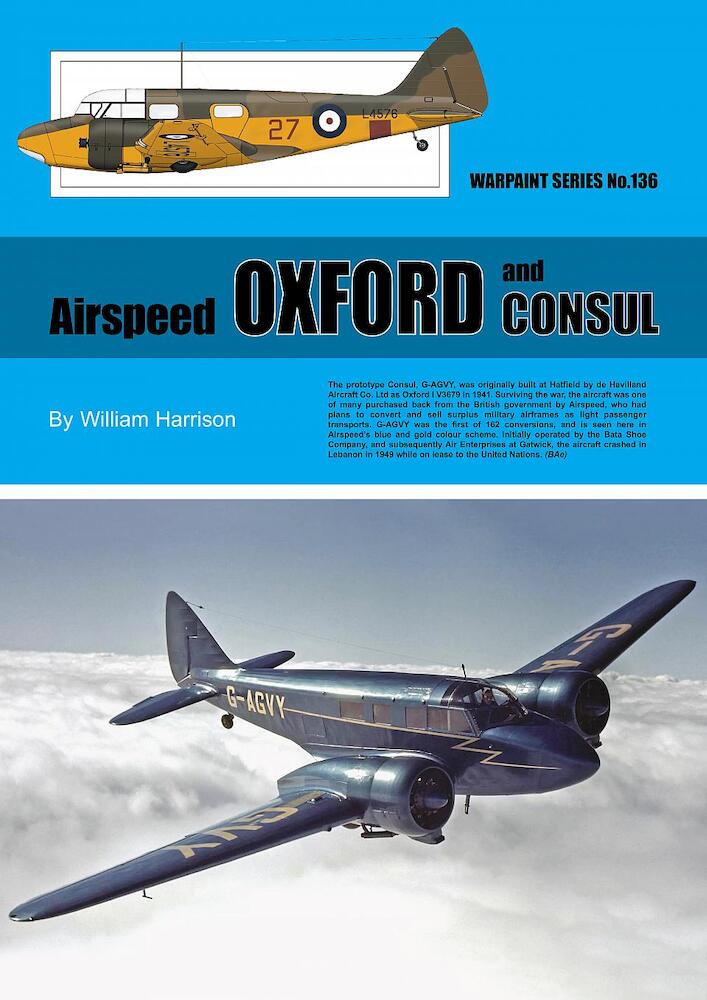
Airspeed Oxford and Consul
Product code ws-136
Airspeed
Series Warpaint Series No 136
Publisher/Brand Hall Park
Author William Harrison
Format a4
No. Pages 52
Version Soft cover
Language English
Category Aviationbooks
Subcategory WW2 UK » WW2 UK Aircraft
Availability only 1 remaining
This product was added to our database on Monday 23 January 2023.
Your reliable Aviation Book Source since 1989
Also in this series:
| Product | Publisher/Brand | Series/scale | Price € | ||
|---|---|---|---|---|---|
 | Boeing B52A-F Stratofortress | Hall Park | Warpaint Series No 132 | € 27.48 | |
 | Bristol Beaufighter | Hall Park | Warpaint Series No 1 | € 12.80 | |
 | Bristol Bulldog | Hall Park | Warpaint Series No 66 | € 14.63 | |
 | Canadair and Commonwealth Sabre | Hall Park | Warpaint Series No 40 | € 15.55 | |
 | Dassault Mystere & Super Mystere | Hall Park | Warpaint Series No 148 | € 17.39 | |
 | Douglas A4 Skyhawk | Hall Park | Warpaint Series No 121 | € 27.48 | |
 | Fairey Firefly F.Mk.1 to U.Mk.9 | Hall Park | Warpaint Series No 28 | € 17.39 | |
 | Grumman F6F HellcatTemporarily Out of Stock. | Hall Park | Warpaint Series No 84 | € 18.30 | |
 | Junkers Ju88 | Hall Park | Warpaint Series No 7 | € 12.80 | |
 | Republic F105 Thunderchief | Hall Park | Warpaint Series No 38 | € 15.55 |
With more than 8,750 built the Oxford was a well thought-out design that was based on their Airspeed Envoy, a similar shaped twin-engine executive air-craft that was used in the early 1930s but the more advanced design of the Oxford suited the military requirement for a three-seat training aircraft. The Oxford was a low-wing cantilever monoplane of advanced design and was produced for the training of pilots in handling modern, multi-engine bomber aircraft. Wooden construction was employed throughout making for a simpler design and easier repairs. Provision was made for instruction in pilot train-ing, aerial photography, navigation, aerial photography, and bombing train-ing. An Armstrong-Whitworth gun turret could be installed for training in aeri-al gunnery. After the War the Consul was conceived as a small airliner, chief-ly converted from ex-military Oxfords with more than 160 rebuilt. These quickly sold to potential airline operators and were eventually used in many countries, some changing hands four or five times. The Oxford and the Con-sul were relatively safe flying machines and with thousands of bomber pilots undertaking their flying training in the type it played a major part in the RAF's war effort, and is widely regarded as a design the manufacturers could be proud of.
This book is written by William Harrison with artwork by Sam Pear-son.
10 pages of Colour Profiles
detailed plans
Over 150 many never seen before images

