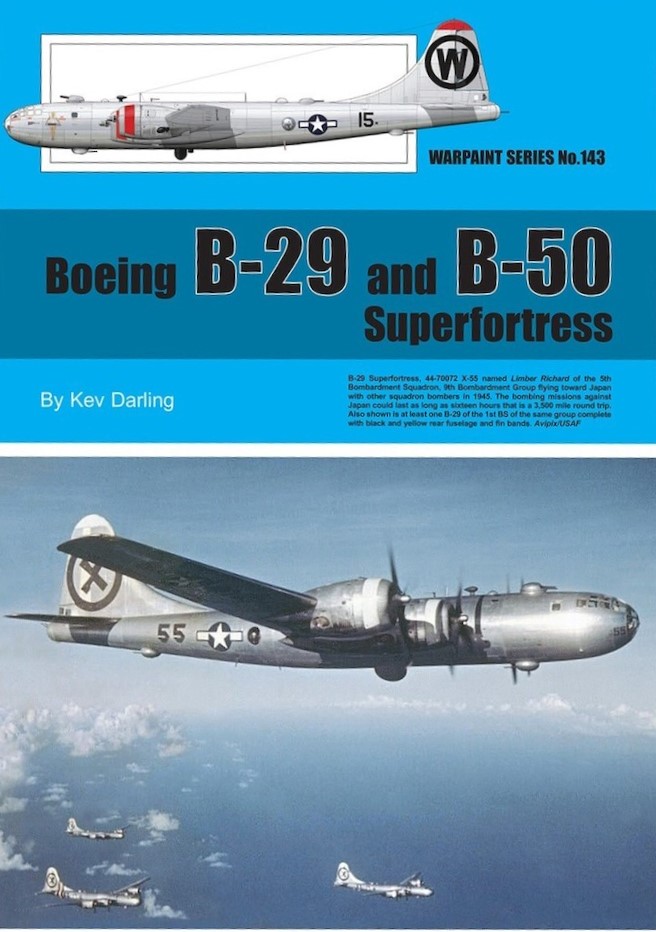
Boeing B29 & B50 Superfortress  WS-143

Boeing B29 & B50 Superfortress

Product code WS-143

Boeing

€ 26.56

:
Add to cart

Series Warpaint Series No 143

Publisher/Brand Hall Park

Author Kev Darling

No. Pages 104

Version Soft cover

Language English

Category Aviationbooks

Subcategory US » US Prop Aircraft

Availability only 2 remaining

Add this product to my wishlist

This product was added to our database on Thursday 18 july 2024.

Your reliable Aviation Book Source since 1989


Also in this series:
ProductPublisher/BrandSeries/scalePrice €
Avro Lincoln Avro LincolnHall ParkWarpaint Series No 34€ 15.55
Bristol Beaufighter BEAUFIGHTEBristol BeaufighterHall ParkWarpaint Series No 1€ 12.80
Fairey Gannet Fairey GannetHall ParkWarpaint Series No 23€ 18.30
Grumman TBM/TBF Avenger WS-87Grumman TBM/TBF AvengerHall ParkWarpaint Series No 87€ 18.30
Mikoyan Gurevich MiG17 ws-124Mikoyan Gurevich MiG17Hall ParkWarpaint Series No 124€ 16.47
Savoia Marchetti SM79 Sparviero WS-61Savoia Marchetti SM79 SparvieroHall ParkWarpaint Series No 61€ 13.72
Short Stirling WS-15Short StirlingHall ParkWarpaint Series No 15€ 16.47
Supermarine Walrus WS-39Supermarine WalrusHall ParkWarpaint Series No 39€ 13.72
Westland Lysander WS-48Westland LysanderHall ParkWarpaint Series No 48€ 15.55
Westland Scout & Wasp ws-110Westland Scout & WaspHall ParkWarpaint Series No 110€ 16.47

Product description

Having launched the signature bomber for use in the European Theatre, Boeing embarked on a voyage into the unknown. Bringing together numerous untried technologies the Boeing Aircraft Company launched its most significant bomber, the B-29 Superfortress. Although beset by development problems and having suffered the loss of the prototype and its Chief Test Pilot Eddie Allan, the company pushed on to create the first long-range strategic bombers.
Once the Pacific Islands had been captured the B-29 Bomb Groups began bombing raids on the Japanese Home Islands. On the other side of the Himalayas further bomb groups launched attacks against targets in Japan. As combat experience grew the focus turned to destroying as much as possible of its production facilities, mainly by firebombing areas known to have these targets. And then the world changed forever. The use of two atom bombs against Hiroshima and Nagasaki had shown the power of the atom. When the Japanese finally surrendered the Cold War arrived to take its place. War in Korea followed, being the swan song for the B-29 while its younger sibling, the B-50, assumed the mantle of Strategic Defence, a position it held until the B-47 Stratojet arrived.

One of the largest aircraft of World War II, the B-29 remained in service in various roles throughout the 1950s, being retired in the early 1960s after 3,970 had been built. The Royal Air Force flew the B-29 with the service name 'Washington from 1950 to 1954' while the re-engined B-50 Superfortress Lucky Lady II became the first aircraft to fly around the world non-stop, during a 94-hour flight in 1949. The Soviet Union produced 847 Tupolev Tu-4s, an unlicensed reverse-engineered copy of the B-29. This latest in the essential Warpaint series offers a comprehensive look at the famous bomber in all its guises, with history, development, service details, and colour artwork and scale plans by Sam Pearson