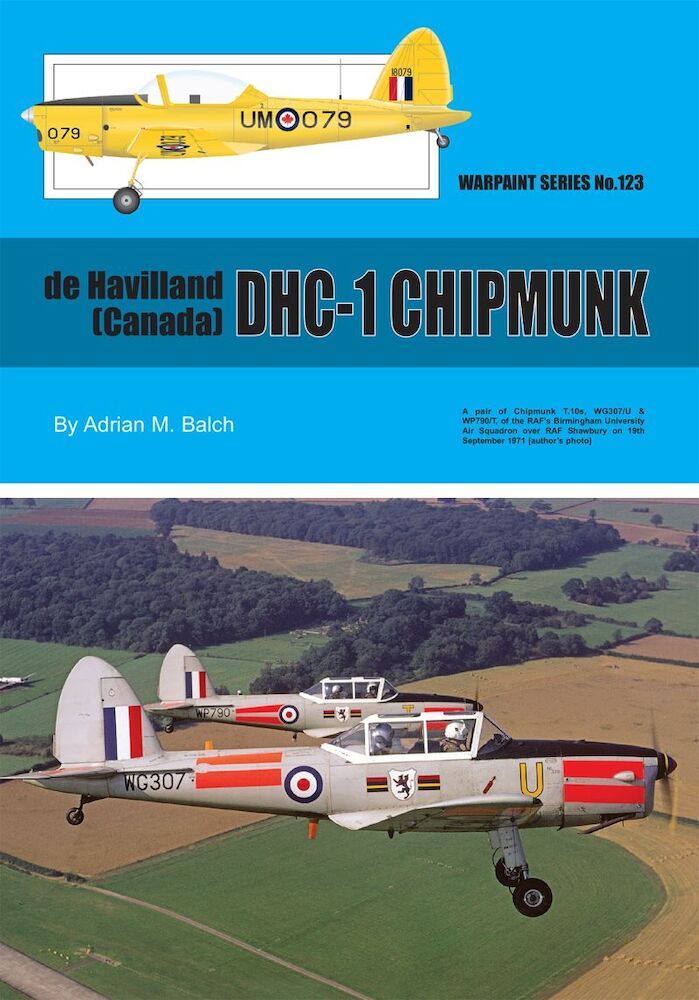
DHC1 Chipmunk
Product code ws-123
Series Warpaint Series No 123
Publisher/Brand Hall Park
Author Adrian M Balch
Format a4
No. Pages 48
Version Soft cover
Language English
Category Aviationbooks
Subcategory UK » UK Prop Aircraft
Availability Temporarily Out of Stock.
Click here to be notified when this product becomes available again
This product was added to our database on Thursday 7 November 2019.
Your reliable Aviation Book Source since 1989
Also in this series:
| Product | Publisher/Brand | Series/scale | Price € | ||
|---|---|---|---|---|---|
 | Boeing B52A-F Stratofortress | Hall Park | Warpaint Series No 132 | € 27.48 | |
 | Bristol Beaufighter | Hall Park | Warpaint Series No 1 | € 12.80 | |
 | De Havilland Vampire (REISSUE!) | Hall Park | Warpaint Series No 27 | € 20.14 | |
 | Fairey Swordfish | Hall Park | Warpaint Series No 12 | € 14.63 | |
 | Grumman OV1 Mohawk | Hall Park | Warpaint Series No 154 | € 33.90 | |
 | Hawker Siddeley HS748 & AndoverTemporarily Out of Stock. | Hall Park | Warpaint Series No 151 | € 20.14 | |
 | Heinkel He177 Greif | Hall Park | Warpaint Series No 33 | € 13.72 | |
 | Junkers Ju88 | Hall Park | Warpaint Series No 7 | € 12.80 | |
 | Martin Mariner and Marlin | Hall Park | Warpaint Series No 108 | € 16.47 | |
 | Panavia Tornado ADV | Hall Park | Warpaint Series No 113 | € 17.39 |
The Chipmunk is probably the most famous and well-known post-war piston-engined basic training aircraft after the Tiger Moth, for which it was designed as a replacement by de Havilland in Canada. It first flew on 22 May 1946 and entered operational service that same year. During the late 1940s and 1950s, the Chipmunk was procured in large numbers for air arms around the world, primarily the Royal Canadian Air Force (RCAF) and the, Royal Air Force (RAF), who utilised it as their standard primary trainer aircraft. The type was also produced under licence by de Havilland in the United Kingdom, who would build the vast majority of Chipmunks, as well as by OGMA (Oficinas Gerais de Material Aeronáutico) in Portugal.The type served with the RAF right up until 1996 in the ab initial training role and many still fly today in civilian guise. This is another quality publication in the Warpaint series by author Adrian Balch, who relates the history of the Chipmunk together with colour scheme details for the modeller, supported by no less than 90 top quality photographs from his archives, the majority of which are in colour. Many colourful profiles are provided by Jan Polc, making this 48-page publication a 'must have' for the aviation historian and modeller alike.

