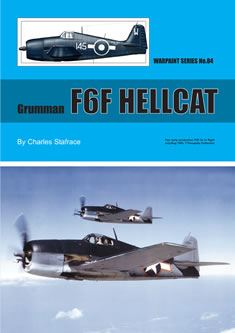
Grumman F6F Hellcat
Product code WS-84
Grumman
Series Warpaint Series No 84
Publisher/Brand Hall Park
Author Charles Staffrace
Format a4
No. Pages 60
Version Soft cover
Language English
Category Aviationbooks
Subcategory WW2 US » WW2 US Aircraft
Availability Temporarily Out of Stock.
Click here to be notified when this product becomes available again
This product was added to our database on Friday 5 August 2011.
Your reliable Aviation Book Source since 1989
Also in this series:
| Product | Publisher/Brand | Series/scale | Price € | ||
|---|---|---|---|---|---|
 | Bristol Bulldog | Hall Park | Warpaint Series No 66 | € 14.63 | |
 | Dassault Mystere & Super Mystere | Hall Park | Warpaint Series No 148 | € 17.39 | |
 | Douglas C47 Skytrain/Dakota | Hall Park | Warpaint Series No 133 | € 30.23 | |
 | Fairey Barracuda | Hall Park | Warpaint Series No 35 | € 13.72 | |
 | Grumman OV1 Mohawk | Hall Park | Warpaint Series No 154 | € 33.90 | |
 | Junkers Ju52 | Hall Park | Warpaint Series No 81 | € 14.63 | |
 | Junkers Ju88 | Hall Park | Warpaint Series No 7 | € 12.80 | |
 | Lockheed Hudson MKI to MKVI | Hall Park | Warpaint Series No 59 | € 14.63 | |
 | Lockheed T33A Shooting StarTemporarily Out of Stock. | Hall Park | Warpaint Series No 88 | € 15.55 | |
 | Westland Scout & Wasp | Hall Park | Warpaint Series No 110 | € 16.47 |
Even before Pearl Harbor the US Navy realised that it would be hard for its existing fighters, the F2A Buffalo and F4F Wildcat, to deal with Japan's shipboard fighters, especially the A6M Zero. The situation was such that in June 1941 the US Navy placed orders with Grumman's 'Iron Works' for the F6F Hellcat before the first prototype had even flown. It was the right decision for Grumman's new fighter, although much larger and heavier than the Zero, proved to be the latter's nemesis, so that the American fighter's better fire-power, sturdiness, range and speed more than matched the Zero's agility. It's entry into service was also timely, for the much- awaited F4U Corsair suffered from a flawed carrier deck capability, so that the Hellcat remained the main carrier fighter of the US Navy throughout the rest of the Second World War and established air superiority in the Pacific. Indeed, in barely two years of war it destroyed no less than 5,271 enemy aircraft of the 6,477 claimed by the US fighters, attaining a fantastic kill-to-loss ratio of 19.1:1, and fully deserving the nickname of 'Ace-Maker'. It certainly was the most important Allied shipboard fighter of that world conflict. The Hellcat was used also by the Royal Navy's Fleet Air Arm, during the war, while in the postwar period it saw service with the French Aéronavale, which used them in Indochina, as well as with the Uruguayan Navy, the latter flying them until 1961.

